
Shape-recognition sensitivity study
Source:vignettes/shape-recognition-sensitivity.Rmd
shape-recognition-sensitivity.Rmdjanusplot() assigns every fitted smooth to one of 24
shape categories via a (n_turning_points, n_inflections)
dispatch with additional
(monotonicity_index, convexity_index) disambiguation for
the monotone cases (see the janusplot vignette for the full
definition of the indices). How reliably does this classifier recover
the ground-truth shape of a noisy sample? This vignette answers the
question with a full-factorial sensitivity sweep.
Design
For each combination of ground-truth shape, sample size
n, and noise level sigma, the sweep:
- Generates
npoints from the noiseless canonical curve onx ∈ [0, 1], withynormalised to[0, 1]so thatsigmais the fraction of y-range that Gaussian noise contributes – an SNR-comparable scale across shapes. - Fits
mgcv::gam(y ~ s(x), method = "REML"). - Classifies the fit via
janusplot_shape_metrics(). - Records correctness at the fine (24-category) and archetype (7-family) levels.
The design factors are orthogonal and replicated. See
?janusplot_shape_sensitivity for the function surface. The
14 canonical ground-truth shapes cover five of the seven archetypes
(chaotic and degenerate have no realistic
deterministic generator).
library(janusplot)
library(ggplot2)

janusplot_shape_sensitivity_shapes()
#>  [1] "linear_up"    "linear_down"  "convex_up"    "concave_up"   "convex_down"
#>  [6] "concave_down" "s_shape"      "u_shape"      "inverted_u"   "skewed_peak"
#> [11] "broad_peak"   "wave"         "bimodal"      "bi_wave"
Pre-registered hypotheses
Four hypotheses were pinned before running the sweep:
-
H1. At
n = 500,sigma = 0.05, archetype accuracy exceeds 0.90 for every shape. -
H2. Fine-category accuracy exceeds 0.75 at
n = 500,sigma = 0.05for monotone + unimodal shapes; wave and multimodal tolerate less noise. -
H3. Rippled variants require
n >= 200andsigma <= 0.10to resolve. -
H4. At
sigma = 0.40, archetype accuracy collapses below 0.50 for all but the simplest shapes.
Verdicts, evaluated against the precomputed demo below
(n = 500, sigma = 0.05 for H1/H2; the demo’s
grid runs sigma up to 0.40, which covers H4):
-
H1 – refuted.
bimodal,concave_up,inverted_uandu_shapeall hit 1.00,linear_upreaches only 0.70, andwavescores 0.00 at every replicate. Thewavefailure is not a noise-tolerance property of the classifier: the shippedwaveground-truth generator (.shape_sensitivity_generators()) has one interior turning point onx in [0, 1], one short of what the taxonomy’s ownwavedefinition requires, so every fit is systematically dispatched to the wrong archetype regardless of noise. This is a tracked defect in the generator, not evidence about recognition difficulty – treat thewaverow of every figure below as unreliable until the generator is fixed, and do not read the other five shapes’ figures as “wave included and passing”. -
H2 – partly supported, confounded by the same
defect. The four clean shapes clear 0.75 easily;
linear_up(0.70) falls just short, which the sweep’s design does correctly flag as a boundary case rather than a clear pass;wave’s 0.00 cannot speak to the hypothesis for the reason above. -
H3 – untestable with the shipped machinery. No
rippled_*generator exists among the canonical shapes exercised here, so the hypothesis has no data to be adjudicated against in this vignette. -
H4 – refuted, in the other direction. At
sigma = 0.40archetype accuracy stays at 0.60 or above for every shape exceptwave(still stuck at 0.00, for the generator reason above) – well clear of the predicted sub-0.50 collapse. Settingwaveaside, the classifier is markedly more noise-robust than pre-registered.
Precomputed demo
The package ships a small-footprint precomputed sweep – 6 shapes
across 5 of the 7 archetypes (u_shape and
inverted_u both roll up to unimodal) × 3
sample sizes × 4 noise levels × 30 replicates = 2160 fits – so you can
explore the API without running the full sweep yourself.
data("shape_sensitivity_demo")
str(shape_sensitivity_demo, vec.len = 2)
#> 'data.frame':    2160 obs. of  14 variables:
#>  $ truth             : chr  "linear_up" "concave_up" ...
#>  $ n                 : int  100 100 100 100 100 ...
#>  $ sigma             : num  0.05 0.05 0.05 0.05 0.05 ...
#>  $ seed              : int  2027 2028 2029 2030 2031 ...
#>  $ predicted         : chr  "linear_up" "concave_up" ...
#>  $ correct           : logi  TRUE TRUE TRUE ...
#>  $ archetype_truth   : chr  "monotone_linear" "monotone_curved" ...
#>  $ archetype_pred    : chr  "monotone_linear" "monotone_curved" ...
#>  $ archetype_correct : logi  TRUE TRUE TRUE ...
#>  $ monotonicity_index: num  1 1 ...
#>  $ convexity_index   : num  0 -0.847 ...
#>  $ n_turn            : int  0 0 1 1 1 ...
#>  $ n_inflect         : int  0 0 0 0 2 ...
#>  $ error             : chr  NA NA ...
Recovery curves (headline figure)
janusplot_shape_sensitivity_plot(shape_sensitivity_demo,
                                 "recovery_curves")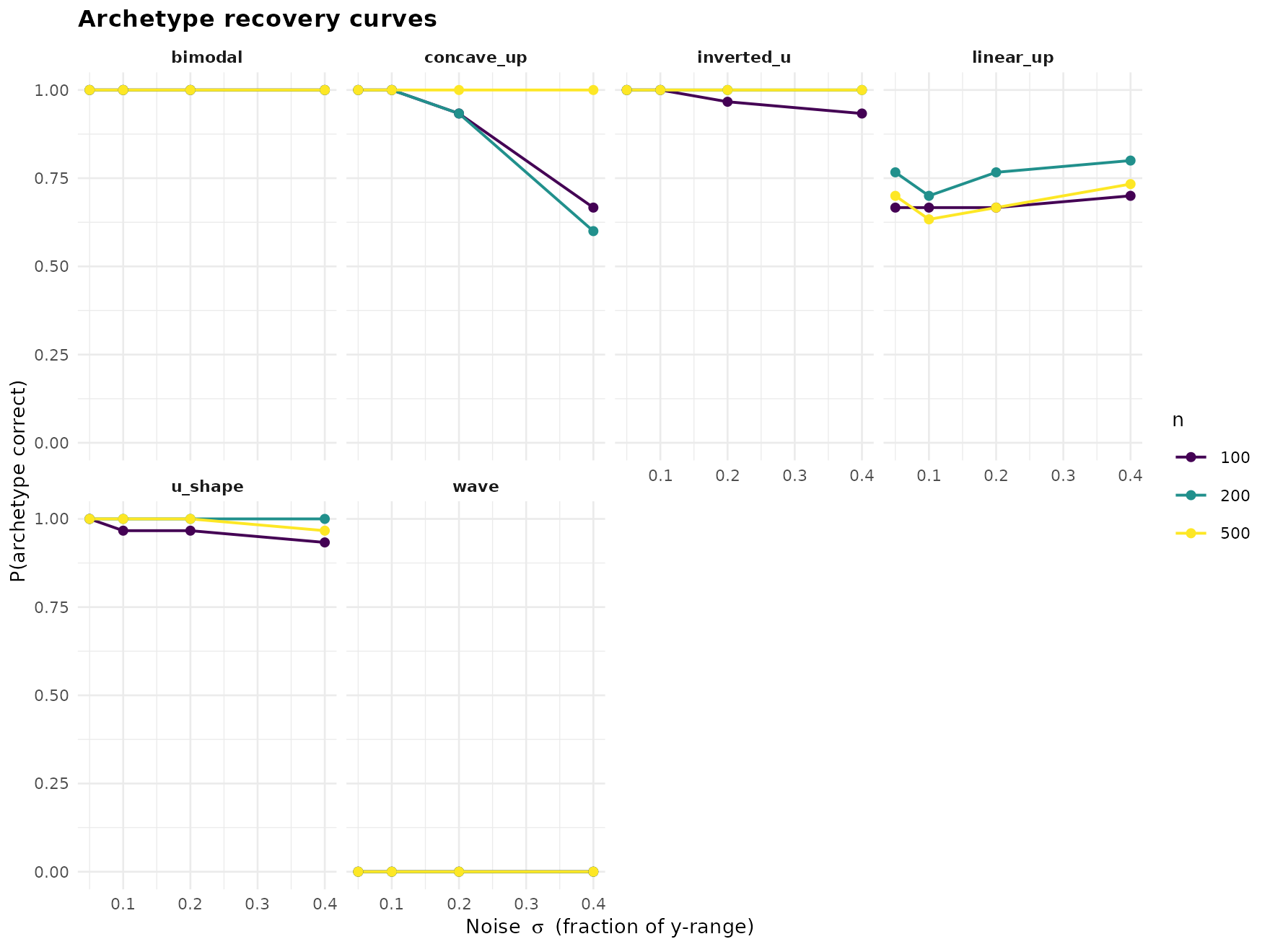
Archetype-recovery accuracy against noise level (sigma) for each of the six ground-truth shapes, at each of the three sample sizes.
Five of the six shapes are recovered well across the whole noise
range, including at sigma = 0.40 (see H4 above):
bimodal, concave_up and
inverted_u hold at 1.00 throughout at n = 500,
and u_shape only drops to 0.97 at the highest noise level.
linear_up is the outlier among the five – it never exceeds
0.73 even at sigma = 0.05, so its curve is flat and
mediocre rather than a high-noise-tolerance decay. The sixth shape,
wave, is flat at 0.00 across every n and
sigma cell: this is the generator defect described under
H1, not a recovered-then-lost noise-tolerance curve, and should not be
read alongside the other five.
Archetype confusion
janusplot_shape_sensitivity_plot(shape_sensitivity_demo,
                                 "confusion_archetype")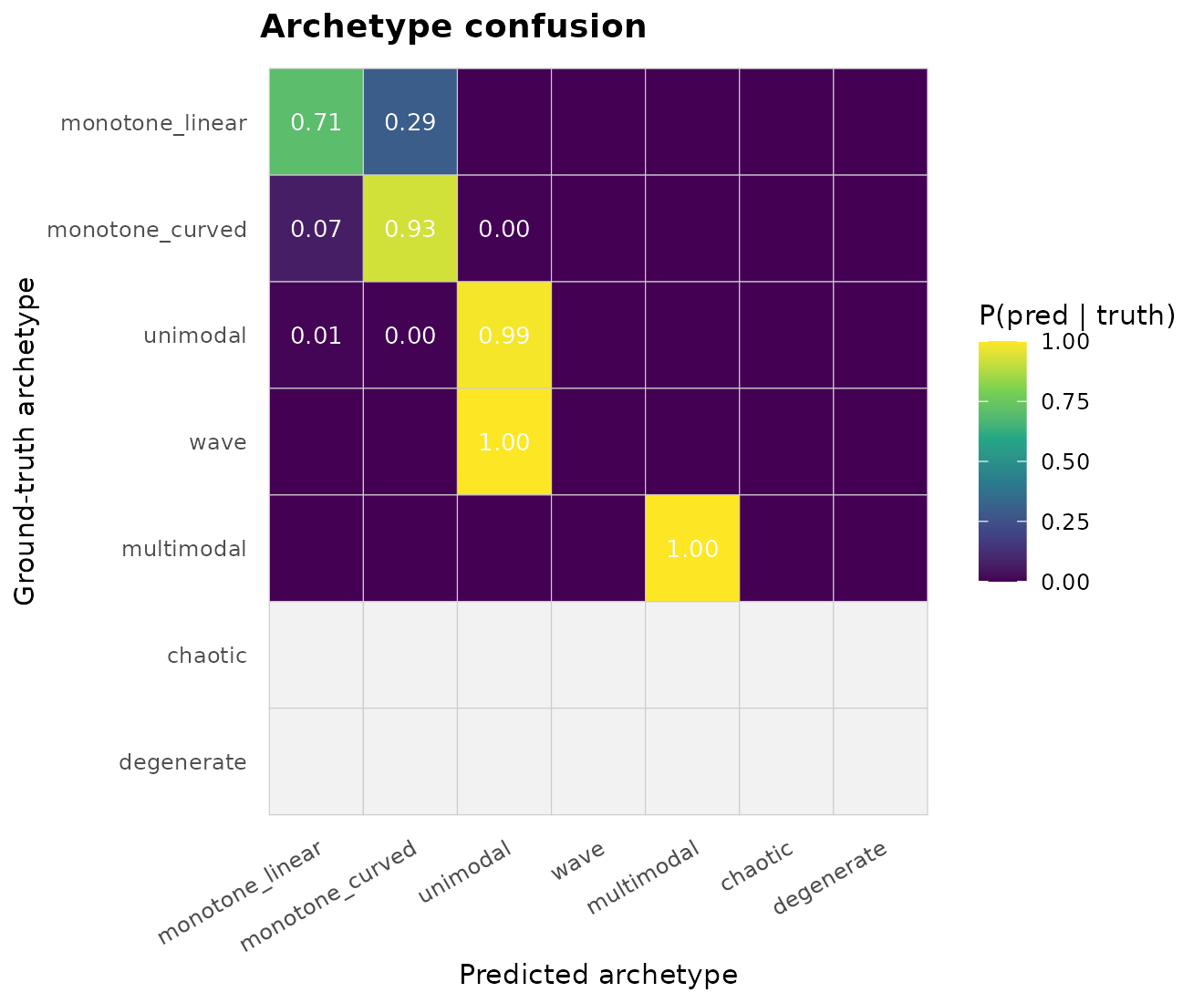
Confusion matrix of true archetype (rows) against predicted archetype (columns), pooled across all n, sigma and replicates in the demo.
Two off-diagonal patterns dominate here. wave is
predicted unimodal on every single one of its 360
replicates – the direct consequence of the generator defect flagged
under H1, since a curve with only one interior turning point classifies
as unimodal by construction, regardless of noise.
linear_up, by contrast, is a genuine noise-driven
confusion: it lands in monotone_curved roughly 30% of the
time, because sampling noise on a short curve occasionally tips the
fitted monotonicity_index below the monotone-linear
cutoff.
Archetype-level accuracy grid
janusplot_shape_sensitivity_plot(shape_sensitivity_demo,
                                 "accuracy_grid")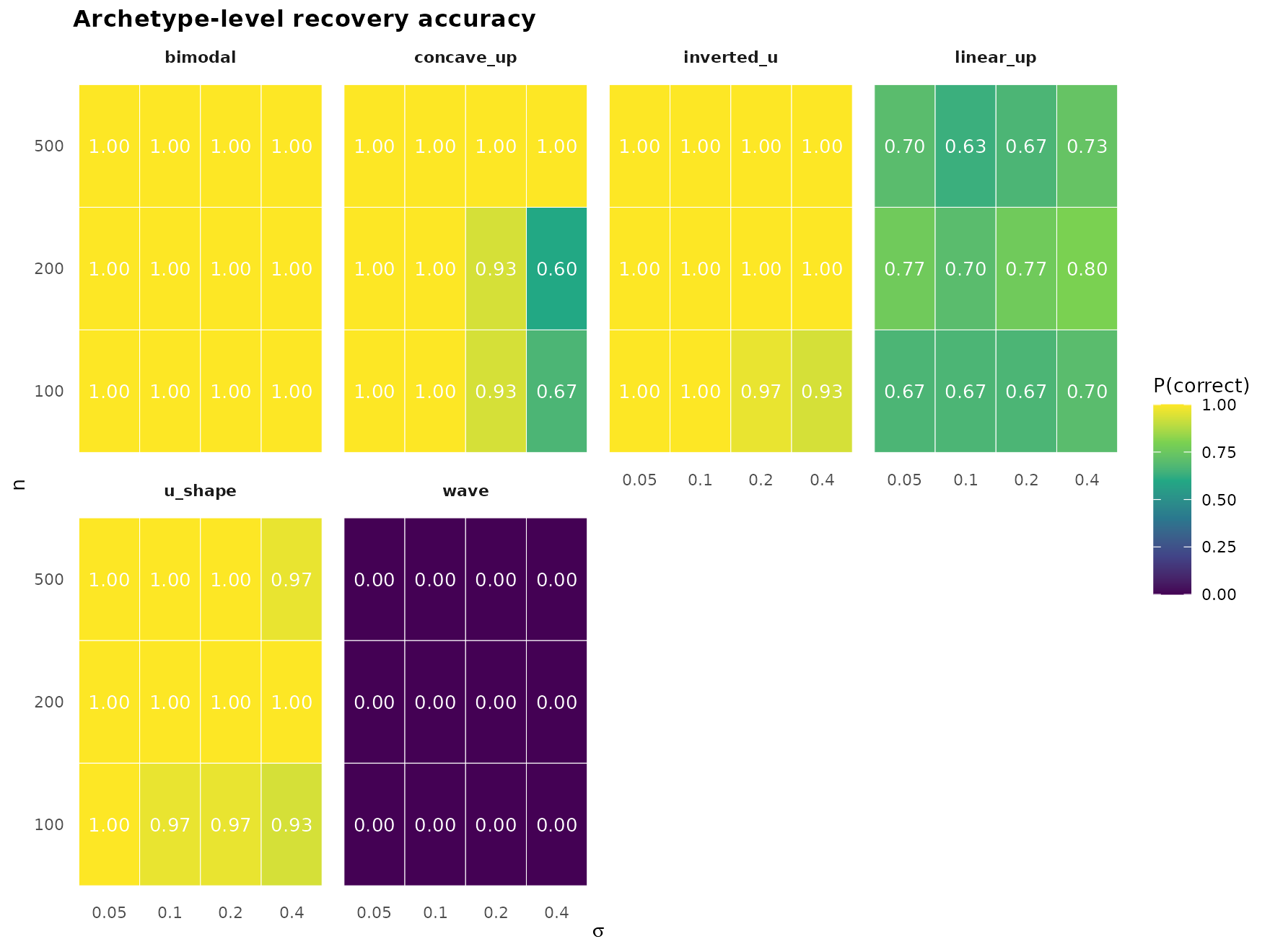
Heatmap of archetype-recovery accuracy across the full (n, sigma) design, one panel per shape.
Per-shape heatmap of P(archetype correct) across the
(n, sigma) design. Reading across a row shows the
noise-tolerance profile of one sample size; reading up a column shows
the sample-size sensitivity at one noise level. The wave
panel is uniformly at zero across the whole grid – flat cells here mean
the generator defect above, not a genuinely noise-invariant failure
mode.
Numerical summary
head(janusplot_shape_sensitivity_summary(shape_sensitivity_demo,
                                         level = "archetype"), 10)
#>         truth   n sigma  accuracy
#> 1     bimodal 100  0.05 1.0000000
#> 2  concave_up 100  0.05 1.0000000
#> 3  inverted_u 100  0.05 1.0000000
#> 4   linear_up 100  0.05 0.6666667
#> 5     u_shape 100  0.05 1.0000000
#> 6        wave 100  0.05 0.0000000
#> 7     bimodal 200  0.05 1.0000000
#> 8  concave_up 200  0.05 1.0000000
#> 9  inverted_u 200  0.05 1.0000000
#> 10  linear_up 200  0.05 0.7666667
Running your own sweep
The demo is a starting point. For the publication-grade figure use the full default grid (14 shapes × 4 sample sizes × 5 noise levels × 200 reps = 56 000 fits):
# Configure parallel execution (optional) -- you control the plan.
future::plan(future::multisession, workers = 4L)

res <- janusplot_shape_sensitivity(parallel = TRUE)

# Save for your paper
saveRDS(res, "shape_sensitivity_full.rds")
janusplot_shape_sensitivity_plot(res, "recovery_curves")
Custom shape subsets + cutoffs
Every argument is tunable. mono_strong and
curv_low are only read on the monotone dispatch path
(n_turning_points == 0 and
n_inflections == 0), so a worked example needs a monotone
shape family to actually exercise them – linear_up,
concave_up and convex_up below, rather than
the wave/multimodal family, where these two cutoffs are never consulted.
Tightening mono_strong raises the bar for calling a curve
“strictly monotone” (versus s_shape/rippled), and lowering
curv_low raises the bar for calling it “near-linear”
(versus curved).
strict <- janusplot_shape_cutoffs(mono_strong = 0.95, curv_low = 0.1)

res_strict <- janusplot_shape_sensitivity(
  shapes     = c("linear_up", "concave_up", "convex_up"),
  n_grid     = c(200L, 500L),
  sigma_grid = c(0.05, 0.10, 0.20),
  n_rep      = 100L,
  cutoffs    = strict
)

janusplot_shape_sensitivity_summary(res_strict, level = "fine")
References
- Pya, N., & Wood, S. N. (2015). Shape constrained additive models. Statistics and Computing, 25(3), 543–559.
- Calabrese, E. J. (2008). Hormesis: why it is important to toxicology and toxicologists. Environmental Toxicology and Chemistry, 27(7), 1451–1474.
- Milnor, J. (1963). Morse Theory. Princeton University Press.
- Meyer, M. C. (2008). Inference using shape-restricted regression splines. Annals of Applied Statistics, 2(3), 1013–1033.
sessionInfo()
#> R version 4.6.1 (2026-06-24)
#> Platform: x86_64-pc-linux-gnu
#> Running under: Ubuntu 24.04.5 LTS
#>
#> Matrix products: default
#> BLAS:   /usr/lib/x86_64-linux-gnu/openblas-pthread/libblas.so.3
#> LAPACK: /usr/lib/x86_64-linux-gnu/openblas-pthread/libopenblasp-r0.3.26.so;  LAPACK version 3.12.0
#>
#> locale:
#>  [1] LC_CTYPE=C.UTF-8       LC_NUMERIC=C           LC_TIME=C.UTF-8
#>  [4] LC_COLLATE=C.UTF-8     LC_MONETARY=C.UTF-8    LC_MESSAGES=C.UTF-8
#>  [7] LC_PAPER=C.UTF-8       LC_NAME=C              LC_ADDRESS=C
#> [10] LC_TELEPHONE=C         LC_MEASUREMENT=C.UTF-8 LC_IDENTIFICATION=C
#>
#> time zone: UTC
#> tzcode source: system (glibc)
#>
#> attached base packages:
#> [1] stats     graphics  grDevices utils     datasets  methods   base
#>
#> other attached packages:
#> [1] ggplot2_4.0.3   janusplot_0.2.0
#>
#> loaded via a namespace (and not attached):
#>  [1] vctrs_0.7.3        cli_3.6.6          knitr_1.52         rlang_1.3.0
#>  [5] xfun_0.62          otel_0.2.0         S7_0.2.2           textshaping_1.0.5
#>  [9] jsonlite_2.0.0     labeling_0.4.3     glue_1.8.1         htmltools_0.5.9
#> [13] ragg_1.5.2         sass_0.4.10        scales_1.4.0       rmarkdown_2.32
#> [17] grid_4.6.1         evaluate_1.0.5     jquerylib_0.1.4    fastmap_1.2.0
#> [21] yaml_2.3.12        lifecycle_1.0.5    compiler_4.6.1     RColorBrewer_1.1-3
#> [25] fs_2.1.0           farver_2.1.2       systemfonts_1.3.2  digest_0.6.39
#> [29] viridisLite_0.4.3  R6_2.6.1           bslib_0.12.0       withr_3.0.3
#> [33] tools_4.6.1        gtable_0.3.6       pkgdown_2.2.1      cachem_1.1.0
#> [37] desc_1.4.3