Why
A field agronomist holds a confidential 72-plot trial and wants an outside statistician to build a spatial yield model against it, but the statistician must never see the real plot layout or genotype identities. The agronomist’s question is practical, not abstract: can I hand over something that behaves like my trial well enough for someone to develop a working pipeline on, and get that pipeline back running unmodified on my real data when they are done? This vignette walks the custodian’s side of that handoff end to end, on the classical John and Williams (1995) alpha-design trial shipped with the package, and answers the question directly by the end.
masque is not an anonymiser, and the synthetic table it
produces is not a public-release-safe artefact – it is a development
surrogate, meant to cross a trust boundary of one: the custodian’s
collaborator. The companion vignette Confidentiality and the threat
model sets out exactly what is and is not protected. Read it before
sharing any output.
What
masque() is the front door: point it at a table (or a
folder or workbook of related tables) and it reads the data, proposes a
masking plan, masks, and – in an interactive session – pauses to let the
custodian review the plan first.
The output of masque() is always a pair: the
synthetic clone, the only part that crosses the trust boundary,
and a private masque_recipe (see recipe())
that never leaves the custodian’s machine. The recipe is what lets a
pipeline written against the synthetic re-target to the original later
with no code change; its internals and the round-trip verbs are the
subject of Recipe anatomy and the round-trip.
Every column in the masking plan carries two independent decisions,
built by propose_roles() and adjusted with
set_role(): a role (what the column is –
design, treatment, outcome,
covariate, date, id,
text, or other) and an action
(how deeply it is masked – keep passes a column through
byte-for-byte, scramble re-simulates numerics through a
Gaussian copula or row-permutes categoricals and dates,
alias scrambles and then replaces the labels with opaque
codes, and drop leaves the column out entirely).
role_options() renders the full grid the validator accepts,
so an incompatible pairing – a design column masque refuses
to scramble, for instance – can be checked before it is attempted.
The mode argument sets the safe defaults for both axes
at once: local is for the custodian’s own development, and
keeps vocabulary intact; collaborate is for handing the
synthetic to someone else, and aliases treatment and categorical labels,
jitters numerics, drops identifiers and free text, and runs the leakage
audit automatically. Per-column action choices always
override the mode’s default.
Do
The one-call path
f <- system.file("extdata", "john_alpha.csv", package = "masque")
df <- read.csv(f, stringsAsFactors = TRUE)
knitr::kable(
  head(df),
  caption = "The first six plots of the alpha-design trial."
)| plot | rep | block | gen | yield | row | col |
|---|---|---|---|---|---|---|
| 1 | R1 | B1 | G11 | 4.1172 | 1 | 1 |
| 2 | R1 | B1 | G04 | 4.4461 | 2 | 1 |
| 3 | R1 | B1 | G05 | 5.8757 | 3 | 1 |
| 4 | R1 | B1 | G22 | 4.5784 | 4 | 1 |
| 5 | R1 | B2 | G21 | 4.6540 | 5 | 1 |
| 6 | R1 | B2 | G10 | 4.1736 | 6 | 1 |
m <- masque(df, mode = "collaborate", seed = 1L, ask = FALSE)
#> ℹ Using the proposed masking plan (pass `roles` or set `ask = TRUE` to review).
#> ✔ Masked 7 columns in "collaborate" mode - audit: 0 HIGH, 0 medium, 7 low.
#> ℹ Recipe is private - keep it. Review `audit_mask(m)` before any release decision; masque informs that decision, it does not make it.
ask = FALSE skips the interactive review, which is what
a vignette needs; in an interactive console, masque(df)
shows the proposed plan and a prompt to proceed, edit, or stop. The
message above is the summary masque() prints for every
guided run: how many columns were masked, in which mode, and the
leakage-audit tally.
The result carries the synthetic data and the private recipe:
synth <- synthetic(m)
knitr::kable(
  head(synth),
  caption = paste0(
    "The first six plots of the synthetic clone: `gen` is aliased, ",
    "`yield` is re-simulated."
  )
)| plot | rep | block | gen | yield | row | col |
|---|---|---|---|---|---|---|
| 1 | R1 | B1 | trt_006 | 4.150347 | 1 | 1 |
| 2 | R1 | B1 | trt_001 | 4.248434 | 2 | 1 |
| 3 | R1 | B1 | trt_019 | 4.578376 | 3 | 1 |
| 4 | R1 | B1 | trt_023 | 5.302792 | 4 | 1 |
| 5 | R1 | B2 | trt_002 | 3.992964 | 5 | 1 |
| 6 | R1 | B2 | trt_014 | 5.255890 | 6 | 1 |
The masking plan: roles and actions
Under the one-call path, masque() built the roles table
without asking. Building and reviewing it directly gives full
control:
roles <- propose_roles(df, mode = "collaborate")
knitr::kable(
  roles[, c("col", "role", "action", "kind")],
  caption = paste0(
    "The proposed masking plan for the alpha-design trial ",
    "(collaborate mode)."
  )
)| col | role | action | kind |
|---|---|---|---|
| plot | design | keep | integer |
| rep | design | keep | factor |
| block | design | keep | factor |
| gen | treatment | alias | factor |
| yield | covariate | scramble | numeric |
| row | design | keep | integer |
| col | design | keep | integer |
propose_roles() fills in a sensible action for each
column given the mode, so the table reviewed here is the plan that will
run. yield was proposed as a covariate; naming
it the trial’s outcome changes nothing about how it is
masked, but it documents intent and is what a downstream consumer such
as the conditional clone (see Confidentiality and the
threat model) reads to find the response:
roles <- set_role(roles, "yield", role = "outcome")
knitr::kable(
  roles[, c("col", "role", "action")],
  caption = "The plan after naming `yield` as the trial outcome."
)| col | role | action |
|---|---|---|
| plot | design | keep |
| rep | design | keep |
| block | design | keep |
| gen | treatment | alias |
| yield | outcome | scramble |
| row | design | keep |
| col | design | keep |
Re-assigning a role re-resolves the default action; passing an
explicit action pins the column instead. There is no
requirement to name an outcome: with none marked, every scrambled
numeric is re-simulated jointly.
Editing the plan as code
The printed table – and the spreadsheet the guided prompt opens when
the custodian chooses e – is an ordinary data frame, so
anything the editor can do, a script can do reproducibly.
set_role() is vectorised over columns:
Direct edits work too. A direct role edit leaves
action untouched, so setting the action back to
NA tells mask() to re-resolve the default for
the new role:
r2$role[r2$col == "rep"] <- "covariate"
r2$action[r2$col == "rep"] <- NA
knitr::kable(
  r2[, c("col", "role", "action")],
  caption = paste0(
    "A hand-edited plan: `row`/`col` dropped, `rep` re-roled to a ",
    "covariate."
  )
)| col | role | action |
|---|---|---|
| plot | design | keep |
| rep | covariate | NA |
| block | design | keep |
| gen | treatment | alias |
| yield | outcome | scramble |
| row | design | drop |
| col | design | drop |
The kind column is derived from the column’s class,
never chosen; editing it changes nothing, and the column should be
converted in the data and re-proposed if the kind is wrong.
role_options() renders the full grid the validator
accepts, filtered by a column’s storage kind:
knitr::kable(
  role_options(kind = "factor"),
  caption = paste0(
    "Every (role, action) pair the validator accepts for a factor ",
    "column."
  )
)| role | action | kinds | notes |
|---|---|---|---|
| design | keep | all | |
| design | alias | factor, character, logical | design label aliasing requires a factor / character / logical column; numeric design columns can only be kept or dropped |
| design | drop | all | |
| treatment | keep | all | |
| treatment | scramble | factor, character, logical | treatment scramble / alias requires a factor / character / logical column; a numeric treatment (e.g. a dose) can only be kept or dropped |
| treatment | alias | factor, character, logical | treatment scramble / alias requires a factor / character / logical column; a numeric treatment (e.g. a dose) can only be kept or dropped |
| treatment | drop | all | |
| outcome | keep | all | |
| outcome | drop | all | |
| covariate | keep | all | |
| covariate | scramble | all except other | columns of an unsupported class can only be kept or dropped; masque does not know how to synthesise them |
| covariate | alias | factor, character, logical | covariate aliasing requires a factor / character / logical column; numeric covariates use scramble |
| covariate | drop | all | |
| date | keep | all | |
| date | drop | all | |
| id | keep | all | |
| id | alias | numeric, integer, factor, character | id aliasing requires a character, factor, or integer column |
| id | drop | all | |
| text | keep | all | |
| text | scramble | all except other | columns of an unsupported class can only be kept or dropped; masque does not know how to synthesise them |
| text | alias | factor, character | text aliasing requires a character or factor column |
| text | drop | all | |
| other | keep | all | |
| other | drop | all |
Finally, pii_suspected. propose_roles()
sets it from the column name (email,
phone, owner, …), and the leakage audit treats
a flagged column that survives into the synthetic as a HIGH finding. The
scan reads names, not content, so when a harmlessly named column holds
sensitive values, flagging it by hand is the correct fix:
roles$pii_suspected[roles$col == "comments"] <- TRUEPassing the edited table back to mask() (or to
masque(df, roles = roles)) runs the plan:
m <- mask(df, roles, mode = "collaborate", seed = 1L)
synth <- synthetic(m)
byte_identical_plot <- identical(synth$plot, df$plot)
gen_levels_changed <- !setequal(levels(synth$gen), levels(df$gen))
byte_identical_plot
#> [1] TRUE
gen_levels_changed
#> [1] TRUE
head(levels(synth$gen))
#> [1] "trt_001" "trt_002" "trt_003" "trt_004" "trt_005" "trt_006"
A refusal you can rely on
Not every role and action pairing makes sense – plot is
a design column, and a design column is structure rather
than content, so asking mask() to scramble it is a request
the package will not carry out:
bad_roles <- set_role(roles, "plot", role = "design", action = "scramble")
mask(df, bad_roles, mode = "collaborate", seed = 1L)
#> Error in `roles_validate()`:
#> ! Incompatible role / action / kind combination(s):
#> ✖ plot (design + scramble): design columns are structure, not content - they cannot be scrambled;
#>   use keep, alias (labels hidden, structure intact), or drop
The call aborts before any masking happens, naming the exact column
and combination at fault and offering the three actions that do make
sense for a design column (keep, alias,
drop). Nothing is silently reinterpreted – an invalid plan
is a refusal, not a best-effort guess, and the same validation runs
whether the plan came from propose_roles(), hand-editing,
or the guided spreadsheet flow.
More than one table
A confidential dataset often arrives as several related files or a
multi-sheet workbook. masque() handles those too – point it
at a folder, an .xlsx file, or a named list of data frames
and it masks every table at once, aliasing any shared key (a site code,
a genotype name) identically across tables so a join of the
synthetic tables still resolves.
set_dir <- system.file("extdata", "met_set", package = "masque")
ms <- masque(set_dir, mode = "collaborate", seed = 1L, ask = FALSE)
#> Warning: Numeric environment column(s) year remain "keep" in collaborate mode.
#> ℹ This preserves environment structure but may disclose year or other numeric labels; review before
#>   release.
#> ℹ Using the proposed masking plan for agronomy (pass `roles` or set `ask = TRUE` to review).
#> ℹ Using the proposed masking plan for quality (pass `roles` or set `ask = TRUE` to review).
#>
#> ── Cross-table links (2) ──
#>
#> • "env" shared across "agronomy, quality" - aliased consistently
#> • "gen" shared across "agronomy, quality" - aliased consistently
#> ✔ Masked 2 tables in "collaborate" mode - audit: 0 HIGH, 0 medium, 12 low.
#> ℹ Recipe is private - keep it. Review `audit_mask(m)` before any release decision; masque informs that decision, it does not make it.
ms
#>
#> ── masque_set ──────────────────────────────────────────────────────────────────────────────────────
#> • Mode: collaborate
#> • Tables: 2
#> • agronomy: 464 row(s) x 7 column(s)
#> • quality: 464 row(s) x 5 column(s)
#>
#> ── Cross-table links (2) ──
#>
#> • "env" shared across "agronomy, quality"
#> • "gen" shared across "agronomy, quality"
#> Use `synthetic(m)` for the tables; `recipe(m)` for the bundle.
#>
#> ✖ The recipe bundle is PRIVATE - never share it with the synthetic set.
The genotype column gen appears in both tables and is
masked to the same codes in each, so the field and laboratory tables
still join. See Confidentiality and the threat model for the
set-level controls.
Multi-environment structure
A multi-environment trial has at least three distinct structural
questions: which rows belong to each environment, whether treatments
connect the environments, and what randomisation structure can be
recovered within each environment. detect_design() reports
these separately; connectivity is a comparability diagnostic, not the
definition of a multi-environment trial, and an observed block or field
layout is evidence, not proof, of the original randomisation
protocol.
A small synthetic toy with two environments and three genotypes makes the three questions concrete:
met <- expand.grid(
  env = factor(c("E1", "E2")),
  rep = factor(seq_len(2L)),
  gen = factor(c("G1", "G2", "G3"))
)
met$yield <- seq_len(nrow(met)) + rep(c(0, 2), each = 6L)

ds <- detect_design(met)
ds@scope_label
#> [1] "multi_environment"
ds@env_cols
#> [1] "env"
ds@connectivity$status
#> [1] "connected"
ds@within_design_label
#> [1] "RCBD"
Automatic detection is deliberately conservative: exact
env/environment names and bounded site-year
patterns are selected only when they pass validity and competition
gates, and a site-only column auto-resolves only when treatments are
replicated across sites, so that a nested block is not promoted into an
environment by mistake. Supplying the basis explicitly is the right call
when domain knowledge is stronger than the recorded names:
ds_explicit <- detect_design(met, env = "env")Figure: the multi-environment coverage plot
plot.design_summary() draws a compact environment
overview by default, in base graphics or, with
engine = "ggplot2", as a ggplot2 object – this
is the figure below. It shows something the two console values above
cannot: whether coverage is even across environments, which a
bare connectivity flag does not distinguish from one environment barely
scraping in.
plot(ds_explicit, df = met, engine = "ggplot2")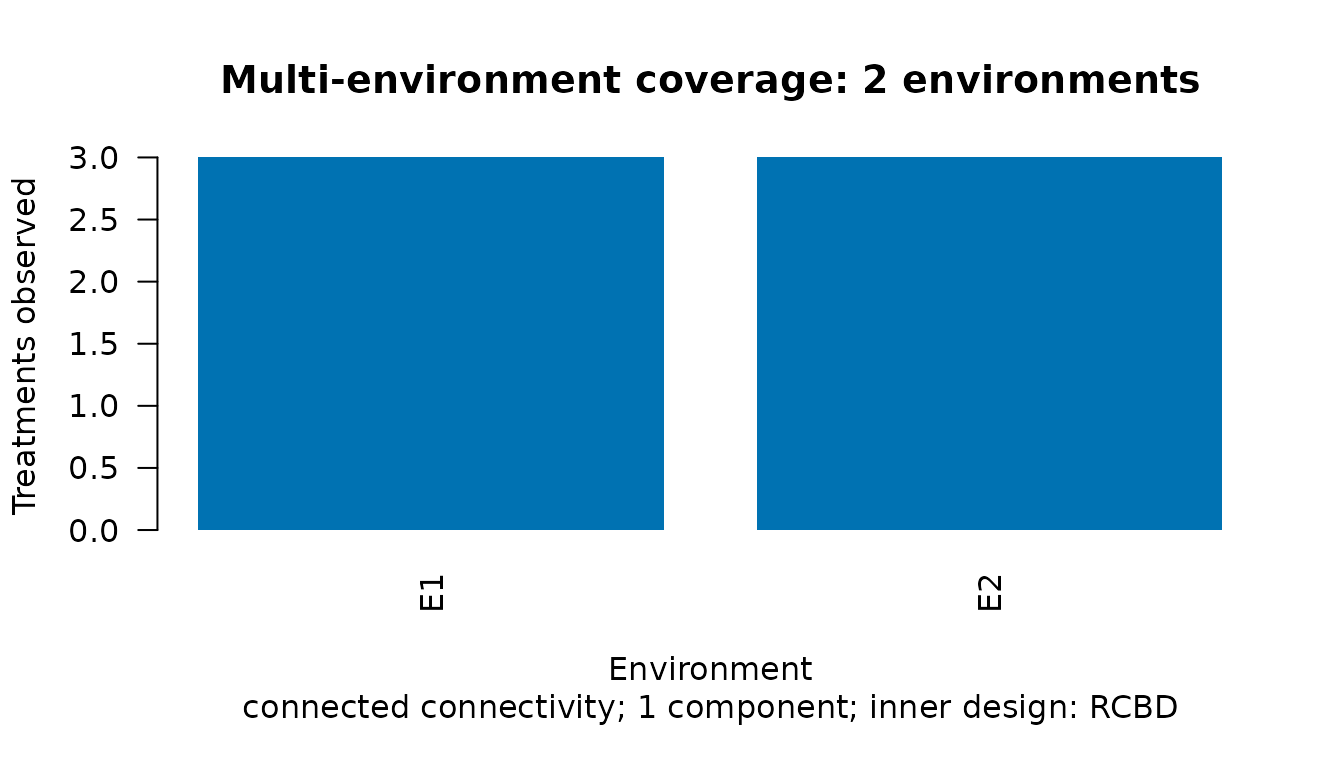
Genotypes observed per environment (E1, E2) for the toy multi-environment trial; the subtitle carries connectivity status, component count, and the recovered within-environment design.
Both bars sit at three treatments observed, because every genotype in this toy trial appears in both environments – that even coverage, together with the subtitle’s connected status and single component, is what makes the two environments comparable at all. A design where a genotype fails to show up in one bar, or where the subtitle reports more than one component, marks environments that cannot be pooled into a single connected analysis without first checking whether the missing coverage is real or an artefact of how the table was assembled.
High-confidence environment recommendations feed the masking plan
directly. Local mode keeps environment values byte-identical;
collaborate mode aliases categorical environment labels in place,
preserving row assignment, factor codes, the NA mask, and recipe
inversion. A numeric environment such as year remains keep
and raises a disclosure warning because its values are still
visible:
met_roles <- propose_roles(met, mode = "collaborate")
knitr::kable(
  met_roles[met_roles$col == "env", c("col", "role", "action")],
  caption = "How the masking plan treats the `env` column."
)| col | role | action |
|---|---|---|
| env | design | alias |
This safeguard protects the allocation a pipeline reads. It does not imply that the synthesised outcomes preserve genotype-by-environment effects: sparse treatment-by-environment cells may fall back to pooled synthesis, and the clone must not be used as a substitute for the original trial in scientific inference.
Read
The one-call run masked all seven columns of the alpha-design trial
in collaborate mode with an audit tally of zero HIGH and zero medium
findings, so nothing about this particular trial needed the custodian’s
attention before the synthetic could be handed over. On the hand-edited
plan, plot – a design column left at
keep – came back TRUE for byte-identity against the
original, while gen – a treatment column
aliased – came back with its levels changed (TRUE): the synthetic
vocabulary is trt_001 through trt_024, not the
original genotype codes, exactly the two-tier behaviour the roles table
promised. The refusal above shows the same plan being checked before it
runs: asking to scramble a design column is rejected outright, not
silently downgraded to something that would run.
The multi-environment toy resolves to connected connectivity with 1
component and a within- environment design of RCBD, which the figure
repeats visually as two equal-height bars – the numbers and the picture
agree because every genotype in this toy happens to appear in both
environments. The met_set fixture masks two related tables
at once and keeps env and gen aliased
identically across both, which is what lets the field and laboratory
tables still join after masking.
Answering the opening question directly: yes, a custodian can hand over a synthetic clone that a collaborator can develop a full pipeline against, while the plot layout, genotype identities, and any linked tables stay tied together exactly as they were, aliased rather than exposed. The other half of that handoff – how the collaborator’s pipeline gets back onto the real data – is Recipe anatomy and the round-trip.
Limits
This vignette shows the custodian’s side of the handoff, on one small
public trial with a clean, complete design; it does not exercise the
leakage audit’s failure modes, the geographic-coordinate controls, or
the conditional clone that preserves a treatment effect rather than only
a marginal distribution, all of which live in Confidentiality and
the threat model. pii_suspected detection reads column
names, not content, so a harmlessly named column holding sensitive
values is caught only if someone flags it by hand, as shown above – the
package cannot infer sensitivity it has no textual evidence for.
Multi-environment detection is deliberately conservative and can
under-detect a genuine environment structure when names and replication
patterns are ambiguous; a domain expert’s explicit env
argument should be preferred over the automatic guess whenever the two
disagree. Finally, this vignette never scrambles or aliases a numeric
column jointly with others, so it does not show what the Gaussian copula
does or does not preserve about the relationship between columns – that
is also Confidentiality and the threat model’s subject.
What to read next
Confidentiality and the threat model sets out exactly what a synthetic clone protects and what it does not, the depth controls beyond role and action, the leakage audit, and the conditional clone that preserves a treatment-to-outcome relationship. Recipe anatomy and the round-trip is the analyst’s side of this handoff: what the recipe carries, and how a pipeline built on the synthetic re-targets to the original.
Reproduce
set.seed(1) is set once for the whole document; every
masque()/mask() call also passes
seed = 1L explicitly, so each is independently reproducible
regardless of what ran before it in this vignette. Package versions
follow.
sessionInfo()
#> R version 4.6.1 (2026-06-24)
#> Platform: x86_64-pc-linux-gnu
#> Running under: Ubuntu 24.04.4 LTS
#>
#> Matrix products: default
#> BLAS:   /usr/lib/x86_64-linux-gnu/openblas-pthread/libblas.so.3
#> LAPACK: /usr/lib/x86_64-linux-gnu/openblas-pthread/libopenblasp-r0.3.26.so;  LAPACK version 3.12.0
#>
#> locale:
#>  [1] LC_CTYPE=C.UTF-8       LC_NUMERIC=C           LC_TIME=C.UTF-8        LC_COLLATE=C.UTF-8
#>  [5] LC_MONETARY=C.UTF-8    LC_MESSAGES=C.UTF-8    LC_PAPER=C.UTF-8       LC_NAME=C
#>  [9] LC_ADDRESS=C           LC_TELEPHONE=C         LC_MEASUREMENT=C.UTF-8 LC_IDENTIFICATION=C
#>
#> time zone: UTC
#> tzcode source: system (glibc)
#>
#> attached base packages:
#> [1] stats     graphics  grDevices utils     datasets  methods   base
#>
#> other attached packages:
#> [1] masque_0.12.0
#>
#> loaded via a namespace (and not attached):
#>  [1] vctrs_0.7.3         cli_3.6.6           knitr_1.51          rlang_1.3.0
#>  [5] xfun_0.60           otel_0.2.0          textshaping_1.0.5   S7_0.2.2
#>  [9] data.table_1.18.6.1 jsonlite_2.0.0      labeling_0.4.3      glue_1.8.1
#> [13] htmltools_0.5.9     ragg_1.5.2          sass_0.4.10         scales_1.4.0
#> [17] rmarkdown_2.32      grid_4.6.1          tibble_3.3.1        evaluate_1.0.5
#> [21] jquerylib_0.1.4     fastmap_1.2.0       yaml_2.3.12         lifecycle_1.0.5
#> [25] compiler_4.6.1      fs_2.1.0            RColorBrewer_1.1-3  pkgconfig_2.0.3
#> [29] systemfonts_1.3.2   farver_2.1.2        digest_0.6.39       R6_2.6.1
#> [33] pillar_1.11.1       magrittr_2.0.5      bslib_0.12.0        withr_3.0.3
#> [37] tools_4.6.1         gtable_0.3.6        pkgdown_2.2.1       ggplot2_4.0.3
#> [41] cachem_1.1.0        desc_1.4.3